Commercial solar on the Gold Coast makes strong financial sense in 2026 — in many cases, more sense than residential. Businesses typically use the majority of their power during daylight hours when solar generates, commercial electricity rates run high, and the depreciation benefits available to businesses can significantly improve the financial case.
If you’re a Gold Coast business owner assessing commercial solar for the first time — or reassessing it after seeing what solar has done for competitors’ overheads — here’s what you need to know.
Key Takeaways
- Commercial solar systems on the Gold Coast typically deliver payback periods of 3–6 years — often faster than residential — because businesses consume power during daylight hours when solar is generating
- Businesses can claim solar systems as a depreciable asset; the Instant Asset Write-Off may apply depending on current ATO eligibility thresholds
- The federal STC rebate applies to commercial systems up to 100kW, reducing upfront costs by 2,000–15,000+ depending on system size
- The STC rebate closes permanently on 31 December 2026 — commercial installers’ schedules are filling up in the second half of the year
- Commercial solar design is materially different to residential — three-phase power, roof load, network connection requirements, and demand tariff structures all affect the right system configuration
Why Commercial Solar Works Especially Well on the Gold Coast
The fundamental advantage of commercial solar is alignment: businesses use power when solar generates it. A retail business, office, warehouse, or hospitality venue running Monday to Friday during business hours is consuming power precisely when the Gold Coast sun is at its strongest.
That alignment means more of what your panels generate gets used directly — at the full value of avoided grid import — rather than being exported at the low feed-in rate. Commercial sites typically self-consume 70–90% of their solar generation. That translates to faster payback, higher savings per dollar invested, and a better overall return than a residential system of equivalent size.
Additional factors that make the Gold Coast strong for commercial solar:
- High commercial electricity rates — often 28–38c per kWh for small businesses in South East Queensland, higher for larger sites on demand tariffs
- Strong solar irradiance year-round
- Roof space on warehouses, factories, and commercial buildings often accommodates much larger systems than residential rooftops
- Network infrastructure on the Gold Coast generally supports larger commercial connection capacity
How Much Does Commercial Solar Cost on the Gold Coast in 2026?
After the federal STC rebate (which applies to systems up to 100kW), approximate installed costs on the Gold Coast in 2026:
| System Size | Typical Business | After-Rebate Cost | Annual Saving | Payback |
|---|---|---|---|---|
| 20–30kW | Café, small office, retail | 18,000–30,000 | 5,000–9,000 | 3–5 years |
| 30–50kW | Medium office, larger retail | 25,000–45,000 | 8,000–15,000 | 3–5 years |
| 50–100kW | Warehouse, light industrial, school | 40,000–80,000 | 14,000–28,000 | 3–6 years |
| 100kW+ | Large commercial, industrial | Quote required | Varies | 3–7 years |
These are indicative ranges. Actual costs and savings depend on your roof, usage profile, network tariff structure, and system design. A properly designed system built around your actual usage will deliver materially better returns than a generic package.
Worth knowing: For commercial sites on demand tariffs — where your peak consumption in any 30-minute window affects your monthly bill — solar can reduce both your energy consumption costs and your demand charges. This requires careful system design to maximise demand reduction during your peak periods. Standard residential-focused installers often don’t optimise for demand tariff structures.
The Tax and Depreciation Advantage for Businesses
Unlike residential customers, businesses can claim solar systems as a depreciable asset — improving the financial case well beyond the energy savings alone.
Depreciation. Commercial solar systems are depreciable plant and equipment. Under standard effective life rules, solar panels are depreciated over 20 years (5% straight-line, or 10% diminishing value). This generates ongoing tax deductions each year for the life of the system.
Instant Asset Write-Off. Depending on current ATO thresholds and your business’s aggregated turnover, you may be able to immediately write off the full cost of the solar system in the year of purchase. Confirm current eligibility with your accountant before purchase — thresholds change.
GST. If your business is GST-registered, you can claim the GST component of the installation cost as an input tax credit on your next BAS.
For many Gold Coast businesses, the after-tax effective cost of a commercial solar system is 25–35% lower than the quoted price — materially shortening the real payback period.
What Makes Commercial Solar Installation Different to Residential
Commercial solar isn’t just a bigger version of a home installation. There are meaningful technical differences that affect system design and installer selection.
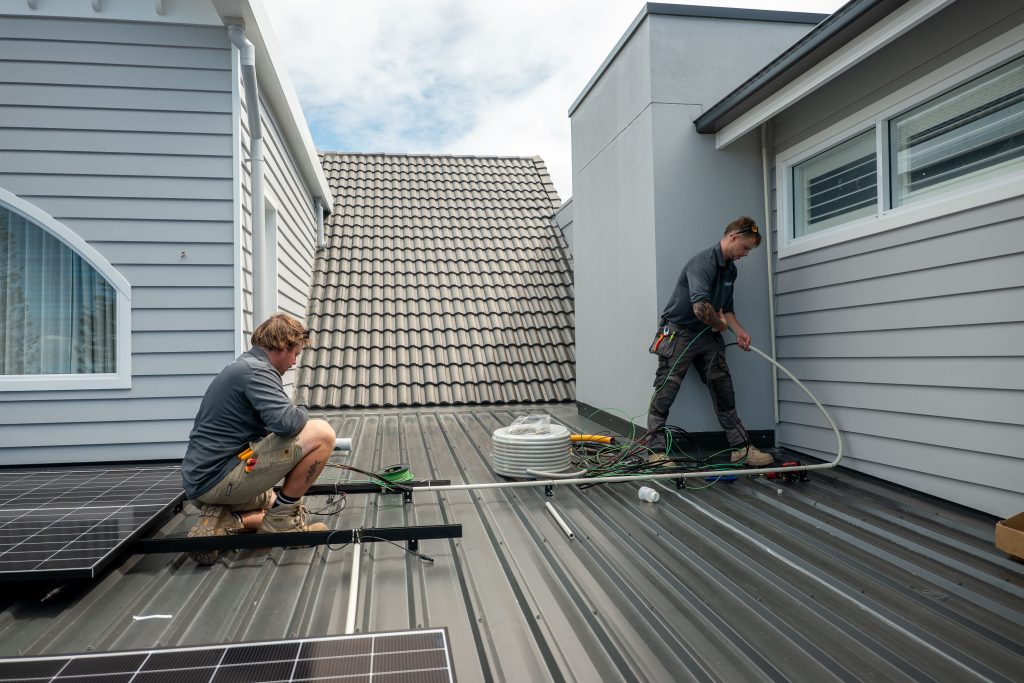
Three-phase power. Most commercial premises run on three-phase power rather than single-phase. Solar design for three-phase sites requires different inverter configurations and careful load balancing — not all residential-focused installers have commercial three-phase experience.
Roof load assessment. Commercial rooftops — particularly older warehouses or factory buildings — may need a structural engineering assessment before a solar array can be installed. A quality commercial installer identifies this during the assessment phase.
Network connection requirements. Larger commercial systems may require a formal network connection agreement with Energex and potentially protection relay equipment. The application and approval process is more involved than a standard residential connection.
System monitoring and reporting. Commercial customers typically need detailed performance monitoring — useful for verifying output, internal energy reporting, and identifying performance issues early. Good commercial installers provide platforms with live generation data, consumption tracking, and exportable reports. Commercial Solar Payback by Business Type — Gold Coast 2026 Commercial Solar Payback — Gold Coast 2026 Café / small business (20–30kW) 3–5 yrs Retail / office (30–50kW) 3–5 yrs Warehouse / industrial (50–100kW) 3–6 yrs Large commercial (100kW+) 3–7 yrs Indicative ranges — actual payback depends on usage, tariff, and system design Approximate commercial solar payback periods for Gold Coast businesses in 2026. Businesses with high daytime usage and demand tariffs typically achieve payback at the faster end of these ranges.
The STC Rebate Closes 31 December 2026
The federal STC rebate applies to commercial systems up to 100kW and closes permanently on 31 December 2026. For a 50kW commercial system, the rebate is typically worth 8,000–12,000 off the installed price. After 31 December, that subsidy is gone entirely.
As the deadline approaches, commercial solar installers’ schedules — which already run longer than residential due to more complex design and connection processes — fill up fast. If you’re considering commercial solar for your Gold Coast business, getting a quote now gives you the best chance of installation before the rebate closes.
At LuxGrid Energy, we work with Gold Coast businesses from small retail operators through to light industrial sites. We design commercial systems around your actual bills, load profile, and tariff structure — not a generic package. Commercial solar done properly should pay for itself well within five years for most Gold Coast businesses.
Get a commercial solar quote from LuxGrid Energy →
Frequently Asked Questions
How much does commercial solar cost on the Gold Coast in 2026?
After the federal STC rebate, a 30kW commercial system typically costs 25,000–35,000 installed. A 50kW system costs approximately 38,000–52,000. Systems over 100kW require individual quotes. Costs vary based on roof type, inverter configuration, and network connection requirements.
What’s the payback period for commercial solar on the Gold Coast?
Most Gold Coast commercial solar installations achieve payback in 3–6 years, depending on system size, daytime usage patterns, and electricity tariff structure. Businesses with high daytime usage and demand tariffs often see the fastest payback.
Can a Gold Coast business claim solar panels as a tax deduction?
Yes. Commercial solar is a depreciable plant and equipment asset. Depending on your business’s turnover and current ATO thresholds, the Instant Asset Write-Off may allow you to claim the full cost in the year of purchase. Confirm eligibility with your accountant before purchasing.
Does the federal STC rebate apply to commercial solar?
Yes — to systems up to 100kW. For larger systems, Large-scale Generation Certificates (LGCs) apply under a different mechanism. The STC scheme closes permanently on 31 December 2026.
How long does a commercial solar installation take on the Gold Coast?
The physical installation takes 1–5 days depending on system size and complexity. The full process from quote to grid connection — including design, network application, installation, and metering — typically takes 4–10 weeks for commercial sites.
LuxGrid Energy designs and installs commercial solar systems across the Gold Coast for businesses of all sizes. Free commercial site assessments, full system design, experienced three-phase installation teams. Contact us for a quote →